
Multiple-choice exams feel like a guessing game until you understand the mechanics behind them — and the person who built the exam had a very specific method. Every question is engineered with one correct answer and several carefully placed wrong ones designed to catch students who half-understood the material. This guide covers how test-writers construct multiple-choice questions and how to turn that knowledge into a reliable strategy for spotting qualifiers, eliminating wrong answers, and guessing wisely.
How Questions Are Constructed: The Stem and the Choices
A well-written multiple-choice question is not just testing whether you know the right answer — it is testing whether you can distinguish the right answer from answers that are almost right. Test-writers start by identifying a core concept, write the correct answer first, then build distractors around it: choices that use familiar course language, address part of the concept, or sound plausible to someone who studied casually. The closer a distractor is to the truth, the more dangerous it is.
The Stem Does Most of the Work
The stem is the question or incomplete statement that appears before the answer choices. It carries the context, the subject, and — crucially — any qualifiers that limit or expand what the correct answer must be. Read the stem in isolation before you look at any choices. Try to answer it in your own words. If you can, you move into the choices in confirmation mode rather than confusion mode, which makes you far less susceptible to distractors.
Distractors Are Not Random
Every wrong answer has a job. The most common types: the partial truth (correct in one part, wrong in another), the opposite (flips a cause-and-effect relationship), the too-extreme (uses absolute language that cannot hold universally), and the scope error (answers a slightly different question than the one asked). Identifying which type you are looking at lets you dismiss it quickly instead of second-guessing yourself.
Qualifiers and Absolute Words: The Words That Change Everything
Absolute Words Are a Red Flag — in Both Directions
Words like always, never, all, none, and only appear in both stems and answer choices. In stems, they narrow what the correct answer must satisfy. In answer choices, absolutes are frequently wrong because most academic claims allow for exceptions. When you see always or never in a choice, ask: can you think of one exception? If yes, eliminate it.
Qualifiers Create Room for Nuance
Words like usually, often, and generally soften a claim and make it harder to disprove. Test-writers use them in correct answers for exactly that reason. When two choices look nearly identical, the one with the qualifier is often the right pick — not always, but reliably enough to check.
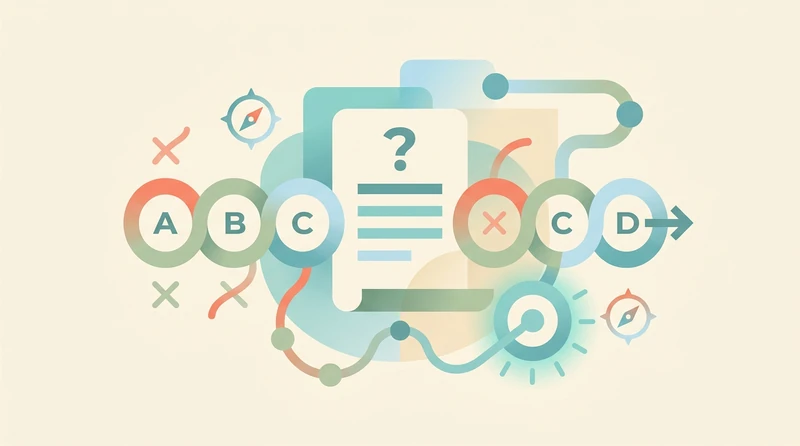
Process of Elimination: Work the Problem Backward
Process of elimination is the single most practical skill you can apply to any multiple-choice question, regardless of how well you know the material.
Eliminate What You Know Is Wrong First
Start by crossing out any choice you can confidently rule out. Even eliminating one option shifts your odds from 25% to 33%. Eliminating two gives you a coin flip. Cross-outs also prevent you from reconsidering a choice you already dismissed — the moment your eye goes back to a wrong answer, overthinking begins.
Compare the Survivors
When two choices remain, stop trying to identify the right one and start looking for the flaw in each. The choice that requires fewer exceptions or has the narrower scope is typically the safer pick. Also check for choices that use language directly from the course textbook — test-writers often pull correct answers nearly verbatim from source material.
When "all of the above" appears, confirming that two individual choices are correct is enough — select it. Test-writers rarely pair a true choice with a false one and then offer that option. When "none of the above" appears, read every choice with extra care before committing; it tends to reward precision.
When to Guess — and How to Do It Strategically
Check the Penalty Rules Before the Exam Starts
Some exams deduct points for wrong answers; most college exams do not. If there is no penalty, leaving a question blank is never the right move — any guess is worth more than zero. If there is a penalty, eliminate at least one or two choices before guessing.
Go With Your First Instinct, Then Commit
Students who change answers are wrong more often than right. Your first response is typically the product of fast, pattern-based recognition; the doubt that follows is usually noise. Unless you recall a specific fact that directly contradicts your original choice, leave it alone.
Skip, Flag, and Return
Spend no more than 60–90 seconds on any single question before flagging it and moving on. Spending four minutes on one hard question while leaving easier ones unanswered is a losing trade. Later questions sometimes contain context clues that unlock earlier ones.
Avoiding Overthinking: The Real Exam Trap
Overthinking on multiple-choice exams is a strategy problem, not a knowledge problem. It happens when a student finds one plausible answer, keeps reading, discovers a second plausible answer, and freezes. The fix is procedural: set a per-question time limit before the exam starts, read the stem and predict an answer, scan the choices once for a match, apply elimination if needed, and move. Disciplined process beats open-ended deliberation every time.
Getting Help with Exam Strategy
If test anxiety is making you second-guess every answer, that problem deserves its own attention. The article on beating test anxiety covers techniques that interrupt anxious thought patterns before and during an exam — breathing protocols, reframing strategies, and pre-exam routines that work in the room itself.
For high-stakes finals where multiple-choice is one section among many, the guide on how to study for finals maps out a full preparation timeline that covers every format you are likely to face.
Conclusion
Reading multiple-choice questions like a test-writer means understanding the rules of the game before you play it. Questions are engineered to separate students who know the material from students who almost know it — and distractors, qualifiers, and absolute words are the mechanisms that do the separating. Apply process of elimination systematically, pay attention to qualifying language, guess strategically when necessary, and commit to your answers without spiraling. Multiple-choice strategy is a learnable skill, and students who treat it as one outperform those who rely on content knowledge alone.
Frequently Asked Questions
What does it mean to "read a multiple-choice question like a test-writer"?
It means understanding the deliberate structure behind how questions are built. Test-writers engineer distractors to target specific misunderstandings and write correct answers with precision. When you recognize that structure, you stop reacting to the exam and start analyzing it.
Should I always avoid answer choices with absolute words like "always" or "never"?
Treat absolute words as a signal to pause, not an automatic reason to eliminate. In most cases, absolute answer choices are wrong because academic concepts rarely hold without exception. However, in mathematics or formal logic, absolutes can be correct — so apply the rule selectively based on the subject.
How does process of elimination improve my multiple-choice strategy?
Eliminating one wrong answer moves your odds from 25% to 33%; eliminating two gives you a coin flip. Crossing out ruled-out choices also prevents you from returning to options you already dismissed — which is where most overthinking starts.
When is it smart to change a multiple-choice answer after you have already chosen one?
Change an answer only when you recall a specific fact that directly contradicts your original choice — not because a different option feels appealing on second read. First-instinct answers are correct more often than switched ones, so a concrete, specific memory is the only valid reason to change.
How much time should I spend on each multiple-choice question?
A reasonable benchmark is 60–90 seconds per question on most college exams. If you hit that limit without a confident answer, flag it, make your best guess, and move on. Returning to flagged questions later gives you a second pass with fresh eyes — and sometimes context from other questions that clarifies the one you were stuck on.
Share this article



Comments 0
No comments yet — be the first.
Leave a comment
Your email will not be published. All fields are required.