
The exam is tomorrow and you are not where you hoped to be — that is an uncomfortable place to sit, and you are far from alone in it. Most students hit at least one exam cycle where something slipped, time ran out, or the material simply didn't click. This guide gives you a calm, triage-based plan for the night before an exam: what to prioritize, what to cut, how to use your remaining hours, and how to walk into the room tomorrow without completely falling apart.
Why Panic Is the First Thing to Manage
Before you open a single note, recognize that a panicked brain is a worse study brain. Anxiety narrows focus, impairs working memory, and makes everything feel equally urgent — which is exactly the opposite of what tonight requires.
Take two minutes to do something that physically slows your heart rate: slow breathing, a short walk, cold water on your face. You are creating the mental conditions under which the next few hours can actually be productive. Accepting where you are — without self-judgment — is what separates useful cramming from frantic page-flipping that leaves nothing behind.
The Triage Step: Decide What Gets Your Time
Not all material deserves equal attention tonight, and trying to cover everything is the single biggest mistake students make at this stage.
Identify the Highest-Yield Topics
Pull out any past quizzes, practice exams, or the professor's review sheet. These signal what the exam is actually testing. Topics that appeared repeatedly in class, showed up on previous assessments, or were explicitly flagged are your highest-yield targets. Go there first.
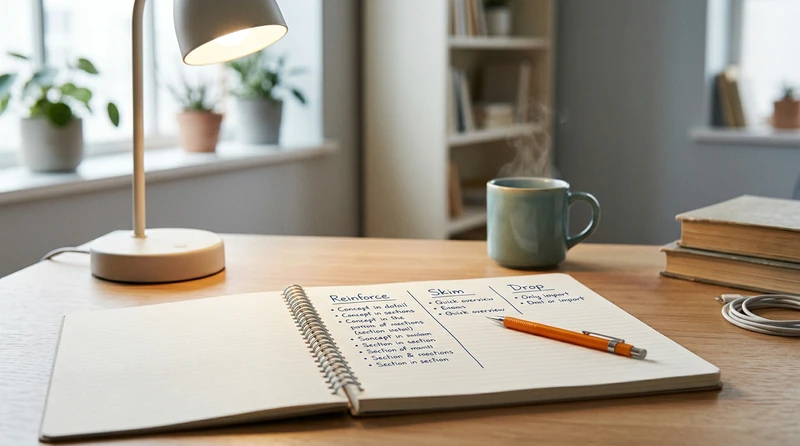
Sort Into Three Buckets
Think of your material in three tiers:
- Reinforce: Topics you sort of know but are shaky on. A small amount of study here produces a meaningful score gain.
- Skim: Topics that are new but appear likely on the exam. One pass only — don't try to master them.
- Drop: Very low-probability or extremely complex topics you haven't touched. Tonight is not the time.
Improving a topic from 40% to 65% knowledge is far more efficient than trying to take something from 0% to useful. Be ruthless.
Build a Hard Stop List
Write down what you are not studying tonight. A written cut list prevents you from compulsively returning to material that won't move the needle. Every time anxiety pulls you toward the skipped pile, the list reminds you the decision was deliberate.
A Realistic Time-Boxed Plan for the Evening
The goal is not to learn everything. The goal is to extract the maximum value from the hours you have before your brain needs to rest.
The Basic Frame
If you have from 7 p.m. to midnight before a morning exam, structure it like this:
- 7:00–7:15 — Triage. Build your study list before you open a single note.
- 7:15–9:00 — First study block. Hit your "Reinforce" tier using active recall: cover notes, retrieve, check. No passive re-reading.
- 9:00–9:15 — Break. Move around, eat something.
- 9:15–10:30 — Second block. Work practice questions; if none exist, write your own from main headings.
- 10:30–10:45 — Skim-tier topics. One pass only.
- 10:45 — Stop. Begin wind-down.
Why Active Recall Over Re-Reading
Re-reading feels productive but produces weak retention under time pressure. Covering material and forcing yourself to retrieve it — even imperfectly — creates stronger memory traces. Use flashcards, past questions, or self-quizzing instead of highlighting.
Keep the Blocks Short
Concentration under stress degrades faster than usual. Forty-five to sixty minute blocks with genuine breaks outperform a three-hour marathon that trails off into distracted scrolling.
The Sleep-vs.-Cramming Trade-Off
This is where students most often make the wrong call, and the research is consistent: sleep wins.
Research shows that students who get at least seven hours of sleep perform measurably better on recall tasks than those who stay up all night. The reason is consolidation — during sleep, the brain moves what you studied from fragile short-term storage into more durable long-term memory. An all-nighter undermines the studying you just did.
The hard stop at 10:45 in the plan above is not arbitrary. If your exam is at 9 a.m. and you need to be up at 7 a.m., be asleep by 11:30 at the latest. Staying up until 2 a.m. to cover two more chapters will likely cost you more points in retrieval failure than it gains in material covered. If you genuinely cannot decide, sleep wins.
The Morning Of
Do not use the morning as a second cramming session. Your brain needs fuel and stability, not a data dump at 7 a.m.
Eat and Hydrate
A real meal — carbohydrates for quick energy, protein to sustain it — matters more than most students give it credit for. Skipping breakfast to study thirty more minutes is almost always a bad trade.
A Light Review, Not a New Session
If you want to look at anything in the morning, limit it to one page of key terms or formulas flagged the night before. This is a retrieval warm-up, not new learning. Set a hard stop at least thirty minutes before you leave.
Arrive Without Time to Spiral
Give yourself enough time that you are not rushing. Rushing spikes cortisol right before you need clear recall. Get to the room, settle in, and breathe. Your job now is to perform, not to keep preparing.
Getting Help Beyond Tonight
One rough exam is not a pattern, but if you repeatedly arrive at exam nights underprepared, the root cause is usually earlier in the process — time management, note quality, or how you process material. It is worth addressing before the next cycle hits.
For strategies to manage test anxiety — both the night-before kind and the in-room kind — the Study Horizon guide on how to beat test anxiety covers evidence-based techniques that go deeper than breathing exercises. If the larger issue is getting your study time organized, the guide on time management for students is a practical place to start.
Conclusion
The night before an exam you're not ready for is stressful, but it is not hopeless. The students who use these hours best are not the ones who study the most — they are the ones who triage clearly, study actively, stop at a sensible hour, and arrive rested enough to use what they actually know. Make your triage list, work your highest-yield topics, and then let your brain do what sleep is for. That is the most effective version of tonight there is.
Frequently Asked Questions
Is it better to sleep or cram the night before an exam?
Sleep is almost always the better choice, especially if you have already done some preparation. Research shows that students who get seven or more hours perform better on recall tasks than those who pull all-nighters, because sleep consolidates what you studied into durable memory. If you must do both, study first then sleep — never the reverse.
How do you decide what to study when you don't have much time?
Start with any practice exams, past quizzes, or the professor's review guide — these signal what the exam is actually testing. Then sort your material into topics you almost know (prioritize), topics that are new (skim or skip), and topics that are low probability (drop). Spending time on familiar-but-shaky material produces the best return when you're not ready for an exam.
Should I pull an all-nighter if the exam is in the morning?
Generally no. An all-nighter leaves you fatigued, raises anxiety, and impairs retrieval right when you need it most. Even four to five hours of sleep is better than zero. If time is very short, study your highest-yield topics for two hours and then sleep whatever remains.
How do I stop panicking the night before an exam?
Name what you know — write a short list of concepts you actually understand. Panic is driven by focusing on the gap rather than on what is retrievable. Then build a concrete plan: specific topics, specific time blocks, a hard stop time. Having a plan shifts your brain from threat mode into task mode, which makes both studying and sleeping easier.
What should I do the morning of an exam I'm not ready for?
Eat a real meal, hydrate, and limit morning review to one page of key terms or formulas you flagged the night before — no new material. Arrive early enough to settle in without rushing. Your goal in the morning is performance, not additional preparation.
Share this article



Comments 0
No comments yet — be the first.
Leave a comment
Your email will not be published. All fields are required.