
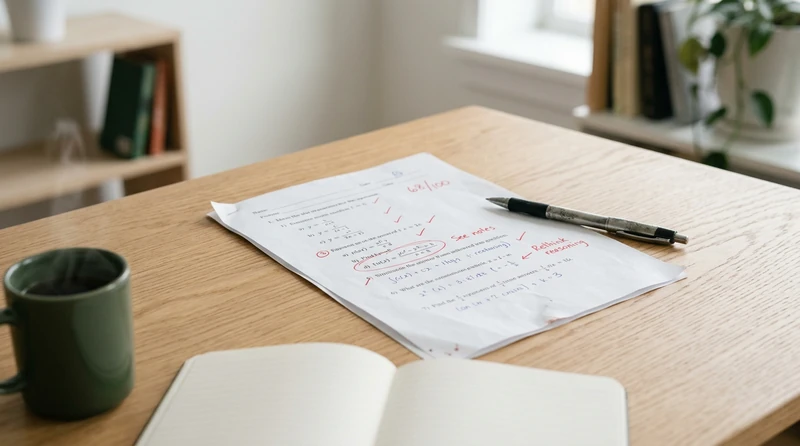
Getting a graded exam back and immediately shoving it in your bag is one of the most expensive habits in college. Every wrong answer is a data point about how you learned, prepared, and performed under pressure — and ignoring those points means repeating the same mistakes next time. This guide walks through the exam post-mortem process: how to categorize your errors, spot the pattern behind them, and translate that into one concrete change before the next test.
Why Most Students Never Improve Between Exams
The standard response to a disappointing grade is to resolve to "study harder" before the next test. That resolution almost never works, because it does not address what actually went wrong. A student who failed to understand a core concept needs different preparation than a student who understood everything but rushed through the exam and made careless arithmetic errors. Studying more of the wrong material, in the same way, produces the same result.
The exam post-mortem — sometimes called an exam wrapper — forces you to diagnose before you treat. Research from Carnegie Mellon and several other universities shows that students who complete a structured post-exam reflection consistently score higher on subsequent tests. It works because it replaces vague guilt with specific, actionable information.
Step 1 — Sit With the Exam Before Anything Else
Block thirty minutes within two days of getting your exam back. Do not wait until the night before the next test — the instructor's feedback is freshest now, and your memory of your reasoning during the exam is still accessible.
Reconstruct Your Thinking
For each wrong answer, ask what led you to your response — not what the correct answer is, but what your reasoning was. Did you misread the question? Did you guess? Did you apply a concept you thought you understood? That reconstruction is where the real diagnostic information lives.
Note the Points at Stake
Write the point value next to each error. A single careless error on a ten-point problem is very different from scattered two-point losses across a dozen concept questions, even if the totals match. Knowing where the big losses happened tells you where to focus first.
Step 2 — Categorize Every Lost Point
This is the core of the exam post-mortem. For each error, assign it to one of four categories — go with your honest first read.
Category 1: Content Gap
You did not know the material. The concept, formula, term, or argument was not in your notes, was not reviewed, or simply did not stick. This is a preparation failure, not a test-day failure.
Category 2: Careless Error
You knew the material but made a mechanical mistake — a sign error, a misread number, an accidentally skipped step, a misread multiple-choice option. If you can look at the question now and immediately see the correct answer without looking it up, it was a careless error.
Category 3: Technique Failure
You understood the concept but could not apply it in the form the question took. The knowledge was there, but the exam tested it in a format you had not practiced — an unusual diagram, a multi-step proof, a synthesis prompt rather than a recall question.
Category 4: Preparation Process
You ran out of time, froze on one section, second-guessed correct answers, or left questions blank you could have attempted. These are test-taking failures that tend to affect whole sections rather than scattered questions — and they require a different fix than content review.

Step 3 — Find the Pattern
Tally up how many points fell into each category. Most students find that one or two categories account for the majority of lost points — and that single fact is more useful than any amount of vague resolve to "do better."
What the Tally Tells You
If content gaps dominate, your preparation was incomplete — identify which topics you under-studied and add the right material, not just more hours. If careless errors dominate, studying more content will not help; build a checking step into your exam-day routine instead. If technique failures dominate, you have studied the right material in the wrong format — add practice problems and past exams. If preparation process failures dominate, the issue is structural: time management in the exam room, or the absence of timed practice before the test.
Spot the Recurring Theme
Look at the specific questions in your largest category. Is it always the same question type — definitions, multi-part problems, synthesis prompts? Always from the same week of lectures? Patterns that specific point directly to the fix.
Step 4 — Change One Concrete Thing
This is where the post-mortem pays off. Pick the single highest-leverage change you can make before the next exam and write it down in plain language. Not "study more" — something specific enough that you could check it off a list.
Examples of Concrete Changes
Content gap: "Make flashcards for every definition in chapters 5–7 and review them every other day." Careless errors: "Reserve the last ten minutes of each exam to re-check any problem worth five or more points." Technique failure: "Work two practice problems per concept type from past exams before the next test." Preparation process: "Take one timed, closed-notes practice exam before test day."
One change followed through is worth more than five changes attempted once.
Step 5 — Use Office Hours to Fill the Gaps
If any error category includes questions you still cannot explain after reviewing your notes, do not skip office hours. Professors and TAs know which concepts tripped up the class, and they can clarify the rubric in five minutes — but only if you arrive with a specific question. "I lost eight points on enzyme kinetics and I'm not sure where my reasoning broke down — can you walk me through question four?" gets a useful answer. "I just want to do better" does not.
Preparing effectively for exams is a learnable skill, not a fixed talent. If your post-mortem keeps pointing to content gaps, examine how you study in the first place — the Study Horizon guide on active recall strategies breaks down the evidence-backed techniques that move material into long-term memory. If test anxiety is shaping your results — second-guessing, freezing, or leaving answers blank — the piece on how to beat test anxiety addresses that problem directly.
Conclusion
Reviewing a returned exam is not about dwelling on a bad grade — it is the most reliable way to avoid repeating the same mistakes. The exam post-mortem turns a frustrating outcome into a specific diagnosis: content gap, careless error, technique failure, or preparation process. Once you know which category is costing the most points, the fix becomes obvious. Identify the pattern, commit to one concrete change, and follow through before the next test. That sequence is what actually moves the needle.
Frequently Asked Questions
What is an exam wrapper and how is it different from just reviewing your test?
An exam wrapper is a structured reflection completed when a graded exam is returned — categorizing mistakes and committing to preparation changes before the next test. Standard review means checking what was wrong and looking up correct answers. The wrapper adds the metacognitive layer: asking why you got it wrong and what that reveals about your process. The same lost points can have very different causes and very different fixes.
How soon after getting an exam back should you do a post-mortem?
Within two to three days is the effective window. Your memory of your reasoning during the exam fades quickly, and the instructor's written feedback is most useful while the exam context is still fresh. Waiting until the night before the next test loses two weeks of lead time to actually implement any changes.
What should I do if I still don't understand why an answer was wrong after reviewing it?
Bring the specific question to office hours. Review your notes first so you can ask precisely — "I re-read chapter six and still can't see why my approach to question four was wrong" gets a useful response; "I don't get it" does not. Understanding the mistake, not just accepting the correct answer, is what prevents it from recurring.
How do I review a returned exam when I made mostly careless errors?
Careless errors are a test-execution problem, not a knowledge problem. Practice slowing down on high-value questions, writing each step explicitly, and reserving time at the end to check your work. Simulate real exam pressure during practice — timed, closed-notes — so that deliberate, methodical pacing becomes a habit.
Can reviewing a returned exam actually improve my grade on the next test?
Yes — students who complete structured post-exam reflections score measurably higher on subsequent exams than those who simply re-read content. The mechanism is specificity: you fix the actual problem rather than adding undifferentiated study time. Write down one concrete behavioral change and follow through on it before the next test.
Share this article



Comments 0
No comments yet — be the first.
Leave a comment
Your email will not be published. All fields are required.