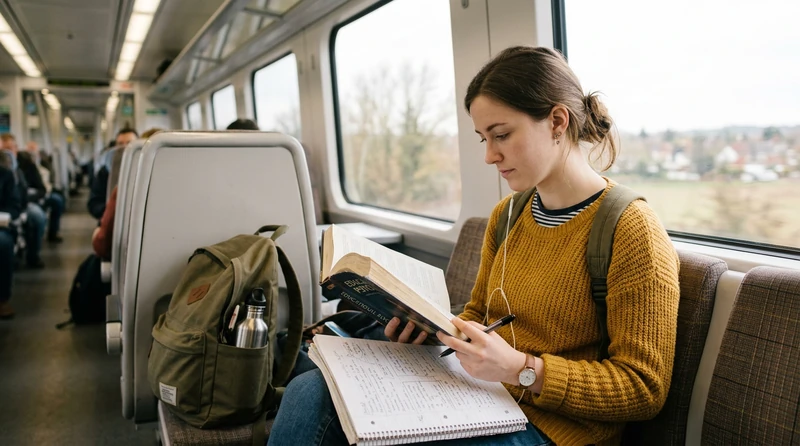
A two-hour daily commute adds up to ten hours a week — time that most college students lose to scrolling or staring out the window. This guide covers how to study while commuting in a way that actually sticks, whether you are on transit or behind the wheel.
Why a Commute Is Harder to Study In Than It Looks
The commute is an interrupted environment. You start, stop, get distracted, and sometimes have to give the train your full attention to find a seat. That unpredictability makes deep cognitive work — problem sets, writing drafts, first-time readings of dense material — genuinely difficult.
The mistake most commuter students make is treating commute time like a desk session. It is not. Once you stop expecting yourself to do your hardest thinking on a moving vehicle and start matching the task to the environment, commute studying becomes much more reliable.
Match the Task to the Mode of Transport
The single most important variable is whether you are driving or on transit. These are entirely different study environments.
Transit Commuters: Visual and Active Review
On a bus, subway, or train you have your hands and eyes free. That opens up a wider range of tasks than most people use. Flashcard review — especially with an app like Anki — is near-perfect for transit: short bursts, self-paced, and easy to pause mid-card when your stop approaches.
Reading is also viable, but keep it to material you have seen before. Re-reading a chapter you already marked up consolidates memory far better than first-pass reading on a jolting bus. Avoid opening a new, dense chapter for the first time during a commute — you will retain almost none of it.
Driving Commuters: Audio Is Your Only Tool — Use It Well
If you drive, your eyes and hands are unavailable. That is a real constraint, not a minor one. Audio is the only legitimate study format for drivers, and attempting anything else is dangerous.
The good news is that audio studying is more powerful than it seems. Record yourself reading key definitions, then answer them aloud after a pause — essentially oral flashcards. Download lecture recordings and re-listen to the twenty minutes you found hardest. Use text-to-speech on exported PDF notes when your platform supports it.
The key for driving commuters is to come prepared. Queue up exactly what you plan to listen to before you pull out of the parking lot. Once you are moving, you should not be picking your material.

Build the Commute Into a Reliable Habit
One hour of commute study that happens every day beats two hours that happen when you feel ready. Reliability matters far more than ideal conditions.
Set a Subject Rotation, Not a To-Do List
A to-do list on a commute fails because tasks are variable in length and you rarely know how much time you will actually have. A rotation does not. Assign each day a subject: Monday and Wednesday are biology review, Tuesday and Thursday are chemistry audio, Friday is any backlog. When you sit down, you already know what you are doing.
Prepare Your Materials the Night Before
Commute studying collapses when the morning starts with "what should I review today?" Spend three minutes the night before queuing your flashcard deck, downloading the lecture file, or earmarking the pages you will read. The commute itself should require zero planning decisions.
Use a Short Wind-Down Ritual
When you arrive, spend sixty seconds writing down what you covered and any question that surfaced. That brief note dramatically improves how much commute material transfers to long-term memory.
What Not to Study on a Commute
Knowing what to leave for your desk is as important as knowing what to bring on the train.
Skip First-Pass Problem Sets
Math and science problem sets require working memory, scratch paper, and the ability to backtrack. A commute offers none of these reliably. Use commute time to review worked examples or listen to a concept explained — but save the actual problem solving for a stable, quiet environment.
Skip Writing and Brand-New Content
Drafting an essay in transit leads to fragmented paragraphs you cannot hold together. Brainstorming and outlining work fine — speaking a rough argument structure into a voice memo is a legitimate commute task. Actual drafting is not. The same logic applies to genuinely new, difficult material: first-time exposure to hard content needs full, uninterrupted attention. Use commute time for retrieval, not initial learning.
Protect the Rest of Your Schedule
A two-hour commute already eats a significant portion of your day. The risk is that it becomes an excuse to let desk study time slip: "I studied on the train, so I don't need to review tonight."
Commute study is supplemental — low-effort, high-frequency review. It does not replace focused desk sessions. Keep your weekly study blocks on your calendar as non-negotiable, and use a weekly reset routine each Sunday to confirm that commute review slots complement rather than replace deep work.
If your schedule is stretched across a job, classes, and a long commute, studying with a job covers how to prioritize when every hour is spoken for.
Tools Worth Having
Keep your toolkit small and already loaded before the semester starts.
Anki handles spaced-repetition flashcards across devices, so decks built at your desk are ready on your phone by morning. Audible or your library's audiobook service covers textbooks with audio versions. Most learning management systems (Canvas, Blackboard, Brightspace) let you download lecture recordings for offline playback — enable that at the start of each term.
For driving commuters, a phone mount is not optional — it keeps your device accessible for queuing audio before you move. A solid Bluetooth connection to your car speakers beats wireless earbuds for safety and consistency on long drives.
Conclusion
Studying while commuting is not about heroics — it is about not wasting the time you already have. Two hours a day compounds across a semester. By matching your task to your transport mode, preparing the night before, keeping a subject rotation, and protecting your desk-study blocks from commute creep, you turn an ordinary part of your routine into a genuine academic advantage. Start with just the morning ride this week.
Frequently Asked Questions
Can you actually learn new material while commuting?
For most students, commute time is better suited to review than to first-time learning. Your attention is partially taken by your surroundings, which makes encoding brand-new, complex information unreliable. Use commute time to reinforce what you have already studied at your desk, and save genuinely new material for a distraction-free environment.
What is the best app for studying while commuting?
Anki is the most widely recommended for spaced-repetition flashcard review and works well on a phone with one hand. For audio, your course's lecture-recording download is free and tied directly to your syllabus. Avoid apps that require extended screen time on crowded transit where a seat is not guaranteed.
How do you study while commuting if you drive?
Driving commuters should rely entirely on audio: re-listened lecture recordings, recorded oral flashcards, or text-to-speech versions of exported notes. Prepare everything before pulling out of your parking spot — selecting audio while driving defeats the purpose and is unsafe. Never attempt to read, write, or look at a screen while driving.
How do you make studying while commuting a consistent habit?
Assign a specific subject to each commute day rather than deciding in the moment, and prepare materials the night before. End each ride with a sixty-second written note of what you covered. Rotation, preparation, and a brief debrief turn sporadic effort into a reliable daily habit.
Does commute studying actually improve grades?
It depends on what you replace. Commute study replacing phone scrolling is almost always worth it; commute study replacing quality desk sessions is not. Used as supplemental review — spaced-repetition flashcards, lecture re-listening — consistent commute studying meaningfully increases retention by exam time.
Share this article



Comments 0
No comments yet — be the first.
Leave a comment
Your email will not be published. All fields are required.