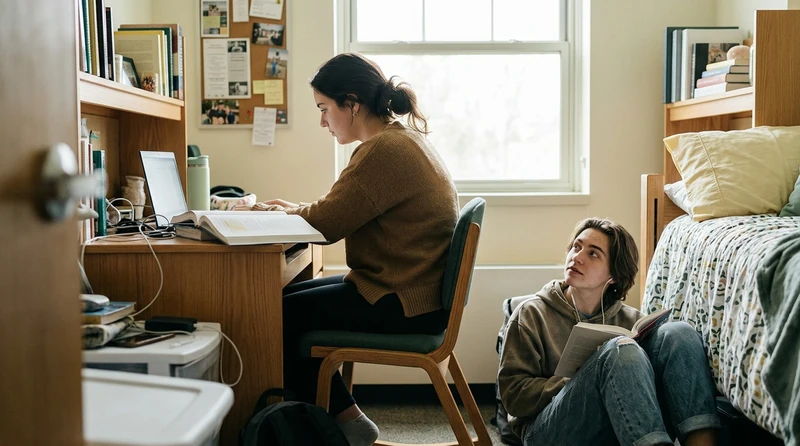
Sharing a small room is already a test of patience — but when your roommate rarely leaves, that room starts to feel like it belongs to them rather than to both of you. The loss of any reliable alone time hits hardest when you need to study, decompress, or simply exist without an audience. This guide covers how to protect your focus and personal space, have the conversation without making things awkward, and recognize when the situation has crossed a line worth escalating.
Why a Roommate Who Never Leaves Creates a Real Problem
A dorm room is roughly 150 square feet of shared territory. When one person occupies it almost constantly, the other loses something every student needs: predictable stretches of time to think without managing someone else's presence.
The problem compounds fast. You start avoiding your own room to escape the discomfort, then you have nowhere to decompress and nowhere to take a private call. What begins as a low-grade annoyance chips away at sleep and concentration.
The difference between a homebody and an actual problem
Some students genuinely prefer their room, and that alone is not a problem. It becomes one when their constant presence prevents you from using the space you pay for, or when it starts affecting your academic performance. Naming that distinction is step one.
Set Expectations Before Frustration Sets In
The most effective roommate conversations happen before anyone is annoyed. If you are early in the semester or just moved in, this is your window — frame it as logistics, not complaints.
The roommate agreement: more useful than it sounds
Most schools offer a roommate agreement through Resident Advisors. Even a casual version — on a whiteboard or shared note — helps. Cover the basics: quiet hours, study-in-room expectations, and how much notice is reasonable before guests arrive. Agreements made early carry far less friction than the same conversation made in frustration at week eight.
Use visual cues to signal "do not disturb"
Headphones are the universal signal. When you put them on and open your books, most roommates understand that as a no-interruption window. Agree on it once: "When I have headphones in at my desk, I need to focus." That one sentence does a lot of work.

Protect Your Study Time Without Waiting for Permission
Relying on the room for focus is a mistake even in ideal roommate situations. A rotation of study spots off-site gives you a reliable fallback the moment the room stops working.
Map three or four spots before you need them
Campus libraries vary floor by floor — the first floor is usually social, upper floors are quiet. Beyond the library, look for department reading rooms, empty seminar rooms between classes, and campus cafes in their slow mid-morning hours. Know these spots before you are desperate; finding them in a panic costs time you do not have.
Schedule deep-focus sessions off-site
Rather than escaping reactively, block library or seminar-room time the same way you block a class — non-negotiable. Your roommate's habits become far less relevant when your best studying was never happening in the room to begin with.
Use your room for lower-stakes tasks
Reserve in-room time for lighter work: reviewing annotated readings, organizing notes, low-stakes writing. Demanding cognitive work — problem sets, drafts, timed review — goes off-site. This division reduces how much your roommate's presence actually costs you.
Having the Conversation Without Conflict
If friction is already building, a direct conversation is unavoidable. The goal is not to change your roommate's personality — it is to negotiate specific behaviors that make the room workable for both of you.
Lead with logistics, not grievances
"I have heavy studying coming up and I'd benefit from a quiet hour or two in the evenings — can we figure out what that looks like?" lands very differently than "You're always here and I can't focus." The first invites collaboration; the second triggers defensiveness. A specific need in a specific time window gives your roommate something concrete to work with.
Agree on one or two small changes
People resist large behavioral asks. A narrow agreement — headphones during certain hours, lower activity one or two evenings per week — is easier to maintain and far less likely to create resentment. Start small, build trust, revisit as needed.
When It Becomes a Genuine Problem Worth Escalating
Most roommate friction is manageable with communication and spatial creativity. But some situations warrant bringing in your RA.
Signs the situation warrants outside help
If your roommate's constant presence reflects social isolation or an unwillingness to attend class, that is a wellbeing concern — not a logistics problem, and not your job to fix alone. If you have had the conversation and nothing changed, or if you feel genuinely uncomfortable in your own room, escalation is appropriate.
Resident Advisors are trained for roommate mediation. Using them is not a betrayal — it is exactly what they are there for. Your RA can facilitate a structured conversation and, if needed, begin the room reassignment process.
Getting Support Beyond the Room
Navigating a difficult roommate dynamic is easier when your own habits are sorted. If productivity is suffering, a weekly reset routine can clarify where your study hours actually live — making you far less dependent on the room being quiet at any given moment. If you are struggling to concentrate even in better environments, the strategies in how to stop procrastinating offer concrete ways to get started when your surroundings feel out of your control.
Conclusion
Sharing a room with a roommate who is always there is more common than most students expect, and the fix is rarely dramatic. Set clear expectations early, build a rotation of study spots outside the room, and have a direct conversation if friction builds. If none of that works, your RA exists for exactly this situation. The room belongs to both of you — and with a little structure, it can actually feel that way.
Frequently Asked Questions
How do I ask my roommate to give me space without being rude?
Frame the ask around a specific need rather than a general complaint. "I have exams coming up and need focused quiet in the evenings — can we figure out what works for both of us?" is harder to take personally than "I need more space." Keep it practical and most roommates will respond reasonably.
What if my roommate is always in the room because they're struggling socially?
You can be friendly without making their social life your responsibility. If the situation involves genuine distress — skipping classes, withdrawing entirely — mention it to your RA. That is a wellness concern beyond roommate logistics, and you should not have to carry it alone.
Is it normal to share a room with a roommate who never leaves?
More common than you might expect, especially first semester when some students are still finding their footing socially. Whether it becomes a genuine problem depends on how much it affects your ability to study and sleep. The constant presence itself is not the issue — the impact on your daily function is.
How do I protect my study time when I share a room with someone who's always there?
Build your primary study sessions off-site — library floors, reading rooms, reserved seminar spaces — rather than relying on the room being quiet. Use headphones as a "do not disturb" signal for lighter in-room work, and set a loose agreement about quiet windows during high-stakes periods.
When should I involve my RA in a roommate conflict?
Involve your RA when a genuine conversation has not produced change, when you feel uncomfortable in your own room, or when your roommate's behavior suggests a wellbeing concern. RAs are trained mediators — using them is not an overreaction.
Share this article


Comments 0
No comments yet — be the first.
Leave a comment
Your email will not be published. All fields are required.