

The syllabus looked manageable in week one. By week three, you have three books open, a stack of journal articles, and a creeping suspicion that no one actually reads all of this. For humanities and social-science students, 200–300 pages of assigned reading per week is the norm, not the exception. This guide covers a realistic system for getting through that load without burning out or falling permanently behind.
Why Reading-Heavy Courses Feel Unmanageable
The volume is only part of the problem. The deeper issue is that most students treat all assigned reading as equal — which means they either try to read everything at full speed and fail, or they give up and read nothing at all.
Academic reading in the humanities is a different cognitive task than reading for pleasure. You are tracking an argument, evaluating evidence, and connecting one scholar's claim to another's. That demands a different set of habits than simply moving your eyes across a page.
Triage: Not All Reading Is Equal
Before opening a single page, decide how deeply each text needs to be read. This one decision changes everything about how manageable your week feels.
Read Closely, Skim, or Skip
Read closely anything the professor discusses directly in lecture, texts tied to exams or essays, and primary sources you will be asked to analyze. These are non-negotiable.
Skim secondary sources that provide context — background histories, supplementary articles, additional case studies. For academic articles, the abstract, methods, and discussion sections give you 80 percent of the argument in a fraction of the time.
Skip or defer readings marked "recommended" rather than required. Note them in case a paper topic makes them relevant later, but do not let optional material crowd out essential texts.
Pre-Read Before You Commit
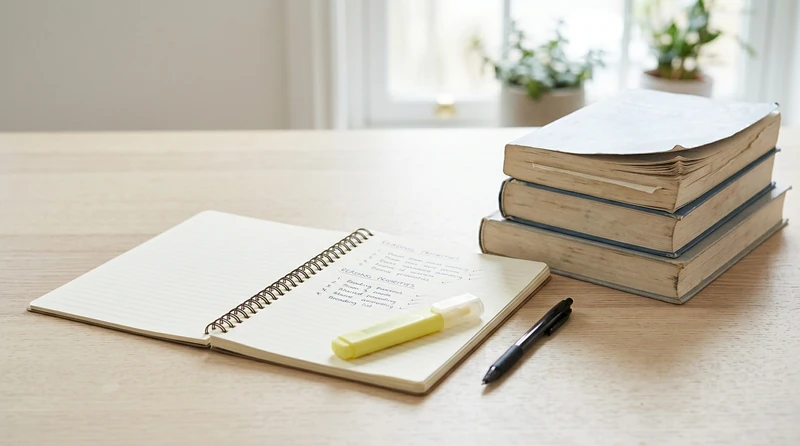
Before settling in for close reading, spend five minutes previewing the text. Scan the title, headings, subheadings, and the final paragraph. For a book chapter, read the first and last page. For a journal article, read the abstract and conclusion first.
Turn Headings Into Questions
As you scan, convert each heading into a question you will read to answer. "The Rise of Industrial Capitalism" becomes "What caused this and why does the author say it matters?" Reading to answer a specific question is dramatically faster than reading to absorb everything. Pre-reading builds a mental scaffold so your brain is filling in a frame it already recognizes — comprehension speeds up and retention improves.
Active Reading and Note Capture
Once you are in the text, active reading means responding to it, not just receiving it. Highlighting is passive and produces nothing useful at review time.
Annotate and Summarize
Write in the margins or a reading document. Mark the thesis, flag each major supporting claim, and note anything you find confusing. One marginal comment per page is enough — more and you have stopped reading and started transcribing.
After each section, write two or three sentences in your own words: the central argument, the key evidence, and one open question. This takes under two minutes and produces the notes you will actually use for papers and discussion. Separating reading from note-taking prevents the passive drift of moving straight through without retaining anything.
Schedule Reading Across the Week
The most common mistake is leaving all reading for the night before class. A block of 80 pages at 11 p.m. is punishing and produces poor comprehension.
Map the Week on Sunday
On Sunday evening, list every reading due that week with its page count. Assign each reading to a specific day before the relevant class session. Aim for no more than 40–50 pages in a single sitting. If a class has 90 pages due Thursday, read 30 on Monday and 60 on Wednesday — or break it into 30-page blocks across three days.
Protect Morning Hours and Use Gaps
Close reading is a morning task. Cognitive load is highest when the brain is fresh, so save your sharpest hours for primary sources and theoretical texts. Short gaps between classes — 30 to 45 minutes — are enough to skim a journal article or read one chapter section. Loading a PDF on your phone before leaving campus turns dead time into productive time without adding an hour to your day.
Recovering When You Fall Behind
Falling behind on readings happens. The question is how to triage the damage without letting one bad week spiral into the rest of the semester.
Prioritize by What Is Due First
Ignore the backlog. Look at what class meets next and what that session requires, then read only what you need for that discussion or assignment. Do not catch up chronologically — catch up by priority.
If you attended lectures on readings you did not finish, your notes are a partial summary of what the professor found most important. Use them to identify which passages were discussed, then read those first.
If you are a full week behind, accept the gap. Stay current and add one 30-minute catch-up block per day. Trying to read two weeks of material in a single weekend fails every time and costs you the current week as well.
Getting Help When the Load Becomes Unmanageable
If your reading load consistently exceeds what any realistic schedule can handle, talk to your professor about what is truly essential. Most professors assign generously and expect students to triage — they will often name which texts are non-negotiable.
If reading a lot but retaining little is the pattern, the issue is usually how you process text, not how much you read. Exploring structured note-taking methods — from Cornell notes to the outline method — can help you convert pages read into knowledge that holds up in exams and essays. And if discussion sections feel disconnected from your readings, knowing how to use office hours effectively gives you a direct line to clarify what the professor wants you to take away.
Conclusion
Keeping up with reading-heavy courses is not about reading faster — it is about reading smarter. Triage ruthlessly, pre-read before you commit, annotate with purpose, and distribute pages across the week rather than cramming them before class. When you fall behind, recover by priority, not chronology. The students who manage dense reading loads are not the ones who read every word — they are the ones who know which words count.
Frequently Asked Questions
How many pages per week is normal for humanities courses?
Two hundred to three hundred pages is common in upper-division humanities and social-science courses, and the volume typically increases as you move to seminar-level classes. Building a sustainable reading system early in your degree matters more than hoping the load will decrease.
Is it okay to skim assigned readings in college?
Yes — strategic skimming is how experienced scholars read. The key is knowing which texts require close reading and which can be skimmed for the argument's shape. Professors who assign 250 pages a week expect you to engage seriously with core texts and extract context from the rest, not read every word at the same depth.
What is the best way to take notes on heavy reading assignments?
Read a section, then stop and write two or three sentences summarizing the central argument in your own words. This forces comprehension and produces notes usable for papers and discussion. Marginal annotation — marking the thesis and key claims as you go — works alongside this.
How do you catch up on reading when you fall behind in a reading-heavy course?
Prioritize by what is due soonest, not by what you missed first. Use lecture notes to identify which parts of the missed texts were discussed and read those sections first. Add a 30-minute catch-up block each day rather than attempting marathon sessions, which produce poor retention and rarely close the gap.
Should you re-read material you did not fully understand?
For primary sources and core theoretical works, a second pass is often worth it before an exam or essay. For secondary readings, consulting your notes and the text's introduction and conclusion is usually faster and just as useful as re-reading in full.
Share this article



Comments 0
No comments yet — be the first.
Leave a comment
Your email will not be published. All fields are required.