
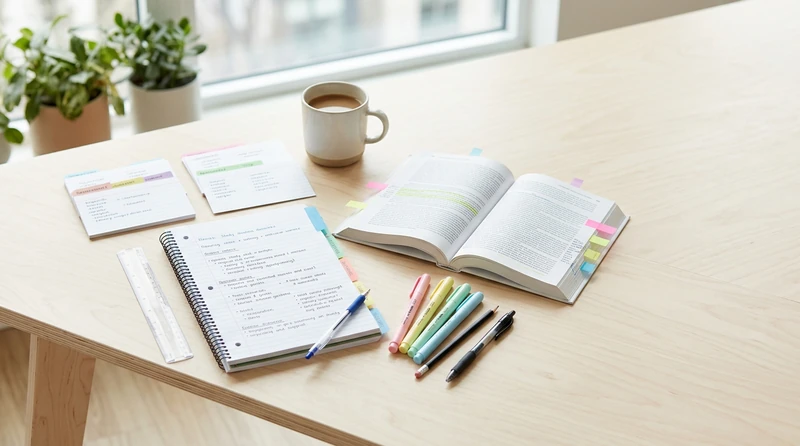
Most students hear "open book" and immediately relax — which is exactly the wrong response. Open-book exams routinely trip up students who treated preparation as optional, because the questions are deliberately designed to punish shallow familiarity with the material. This guide covers how to prepare for an open-book exam so your notes become an asset rather than a crutch you never had time to use.
Why Open-Book Exams Are Often Harder Than Closed-Book Tests
The logic seems obvious: if you can look everything up, the pressure disappears. In practice, the opposite is true. Instructors know you have access to the textbook, so they don't ask you to recall a definition — they ask you to apply it, compare two frameworks, evaluate an argument, or synthesize ideas from three different chapters. Those are higher-order tasks that require genuine understanding, not the ability to find a page number in thirty seconds.
Time is the other trap. An open-book exam gives you an unlimited pool of material to search, and searching is slow. Every minute spent flipping through an unmarked textbook is a minute not spent constructing an answer. Students who walk in unprepared routinely run out of time — not because the questions are unanswerable, but because they spend the first half of the exam just figuring out where to look.
Ditch the Misconception: You Still Have to Study
The most damaging open-book exam myth is that preparation is unnecessary. You need enough familiarity with the material that you can recognise which section is relevant when a question lands in front of you. Think of your notes as a filing cabinet: if you have never looked inside it, you cannot find anything quickly under pressure.
Study the Way You Would for Any Exam
Work through the material using active recall — close the book, reconstruct key concepts from memory, then check. This sounds counterintuitive when you know you can look things up, but it is precisely this practice that builds the conceptual map you need. Students who rely on passive re-reading discover on exam day that everything looks vaguely familiar but nothing is retrievable on demand.
Know What the Questions Will Actually Look Like
Get past papers and look at how your professor has framed questions in previous semesters. Open-book questions cluster around a few patterns: case-based application, compare-and-contrast, and extended argument prompts. Knowing the format tells you what depth your notes need to support.
Build a Usable Reference Sheet or Custom Index
Your textbook is not a reference tool unless you turn it into one. The goal is to spend the exam answering questions, not conducting a search operation.
Create a One-Page Topic Map
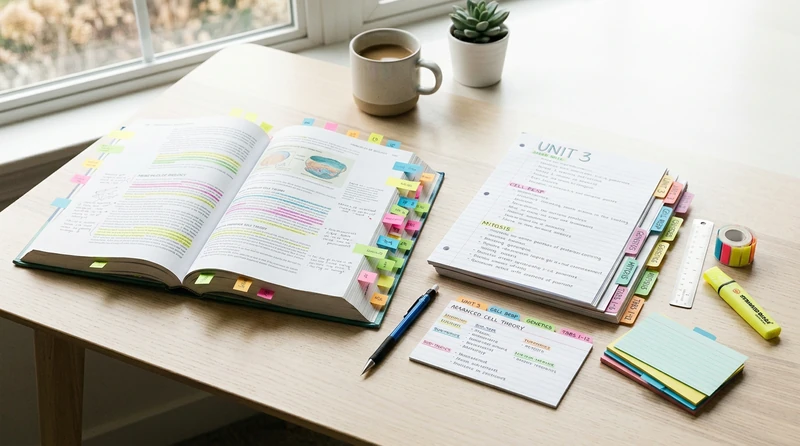
Before the exam, write a single-page index listing every major topic, the core concept in one sentence, and the exact page or section where the full explanation lives. If you are allowed printed notes, this map alone is more valuable than fifty pages of highlighted textbook passages you have never synthesized.
Tab Your Materials Strategically
Label tabs with the concept itself — "supply-demand equilibrium," "Freudian defense mechanisms," "breach of contract elements" — not vague headers like "Chapter 4." Colour-code by topic or question type if it helps. The moment you need to look something up, your eyes should land on the right tab in under five seconds.
Trim Your Materials Down
More is not better. Bringing every handout from the semester creates a search problem, not a solution. Be selective: include condensed notes, your topic index, and any approved reference sheets. Remove anything that duplicates what is already on your index. The leaner your reference set, the faster you move.
Practice Retrieval Even Though It's Open Book
This is the step most students skip, and it explains why so many open-book exam scores are disappointing.
Run Timed Practice Questions with Notes Closed
Do at least two full practice sessions answering past questions without opening anything. Then check your answers against your notes. The gap between what you thought you knew and what you actually knew is the gap to close before exam day — active recall tightens it faster than any other method.
Simulate Using Your Reference Materials
After the no-notes run, do another practice round using your index and tabbed materials exactly as you plan to on exam day. Time yourself. You will quickly discover which tabs are missing, which index entries are too vague, and how much time a single lookup actually costs — which motivates you to rely on materials as little as possible.
Time Management During the Exam
Assume every lookup costs two to three minutes when you factor in finding the section, reading it, and connecting it back to the question. That cost compounds fast.
Answer First, Look Up Second
Write your core answer from memory first, then use your notes to confirm a figure, add a detail, or check a precise definition. This order — answer first, verify second — keeps you moving and prevents the paralysis of reading your entire textbook before committing a single sentence to paper.
Set Per-Question Time Limits
Divide available time by the number of questions and mark a hard cutoff for each. If you hit the cutoff and are still searching, write your best answer and move on. A partial answer on every question almost always outscores a perfect answer on two with blanks everywhere else.
Do Not Over-Explain
Open-book answers tend to balloon because students copy long passages to justify themselves. Paraphrase instead. Examiners want evidence that you understand the material, not that you can locate it — concise, precise answers demonstrate mastery; walls of quoted text do not.
Getting the Most Out of Your Preparation
Open-book exams reward the same habits that make any exam manageable: spaced study, active recall, and organised materials. The guides on active recall and beating test anxiety are worth reading before your next exam — both apply directly to the open-book context, where confidence in your own knowledge keeps you from wasting time searching for answers you already have.
Conclusion
Preparing for an open-book exam is not easier than a closed-book one — it is different, and in many ways more demanding. The students who perform well treat it as an application exercise, build a genuinely usable reference system, and practice retrieval enough that their notes become a backup rather than a lifeline. Start at least five days out, build your topic index early, and run timed practice questions with and without your materials. Performance on an open-book exam reflects the work you put in before you ever open the book.
Frequently Asked Questions
Is an open-book exam easier than a closed-book exam?
Not usually. Open-book exams are specifically designed to test analysis, application, and synthesis rather than memorisation, so the questions are more complex. Time pressure also increases because looking things up during the exam is slower than recalling them from memory.
How do I prepare for an open-book exam if I have limited study time?
Prioritise building a one-page topic index over re-reading the textbook, then do at least one timed practice session with past questions. Knowing roughly where information lives is more valuable under time pressure than knowing every detail it contains.
What should I bring to an open-book exam?
Bring condensed, organised materials: your topic index, tabbed notes or textbook, and any approved formula sheets. Avoid bringing everything you own — a large, disorganised pile makes lookups slower, not faster.
How do I manage my time during an open-book exam?
Answer each question from memory first, then consult materials only to verify specifics. Set a per-question time limit and stick to it. If you are still searching when the cutoff arrives, write your best partial answer and move on.
Should I still practice retrieval when preparing for an open-book exam?
Yes. Retrieval practice is essential for open-book exams. Running through questions without your notes builds a mental map of the material so you can locate information quickly on exam day and spend your time constructing answers rather than hunting for basic concepts.
Share this article


Comments 0
No comments yet — be the first.
Leave a comment
Your email will not be published. All fields are required.