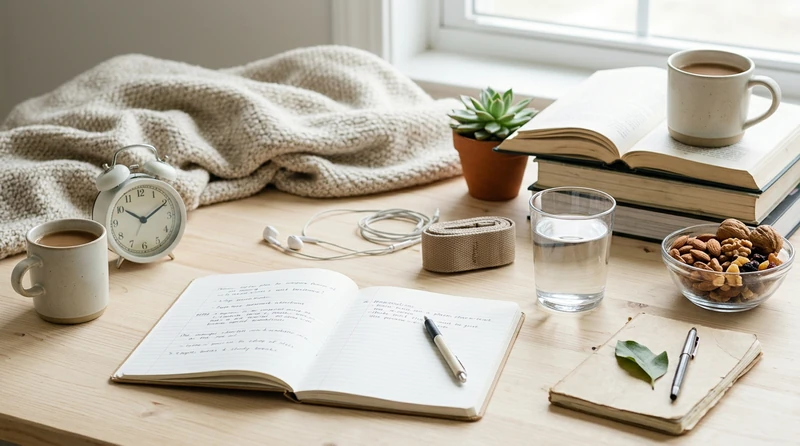
Finals season has a way of making every healthy habit feel like a luxury you cannot afford right now. The instinct to sleep less, skip meals, and push through without breaks sounds reasonable under pressure — but it almost always makes things worse, not better. This guide covers five sustainable basics that keep you functional through the hardest weeks of the term, without asking you to overhaul your life mid-semester.
Why Self-Care Collapses During Finals (and Why That Backfires)
The pressure of finals compresses everything. Deadlines stack, exams overlap, and the first things to go are the ones that feel optional: sleep, meals, movement, downtime. None of those are actually optional for a working brain.
Sleep deprivation impairs memory consolidation — the exact process your brain uses to lock in what you studied. Skipping meals causes energy crashes that shorten your effective study window. Cutting breaks increases errors, not output. Letting your self-care basics collapse is not a trade-off; it is paying full price for half the result.
Sleep: Protect the Floor
Sleep is where most students make the biggest mistake, and the one with the clearest academic cost.
Set a Non-Negotiable Bedtime
Seven hours is the realistic floor during finals. Below six, cognitive performance drops sharply — studies put the impairment at roughly the same level as mild intoxication. You will feel like you are studying, but retention falls off significantly. Set a bedtime and protect it even when it feels like you should keep going.
All-nighters the night before an exam are nearly always counterproductive. A short review session followed by seven hours of sleep outperforms a sleepless night of notes. If the material is not solid by the night before, exhausted cramming will not fix it.
Use Naps Strategically
A 20-minute nap between study sessions can restore alertness without disrupting your night. Keep naps early in the afternoon — anything after 4 p.m. makes it harder to fall asleep at your target bedtime, which starts the deficit cycle over again.
Food: Functional, Not Perfect
Nutrition during finals does not need to be elaborate. The goal is avoiding the crash-and-burn pattern that derails long study sessions.
Eat on a Rough Schedule
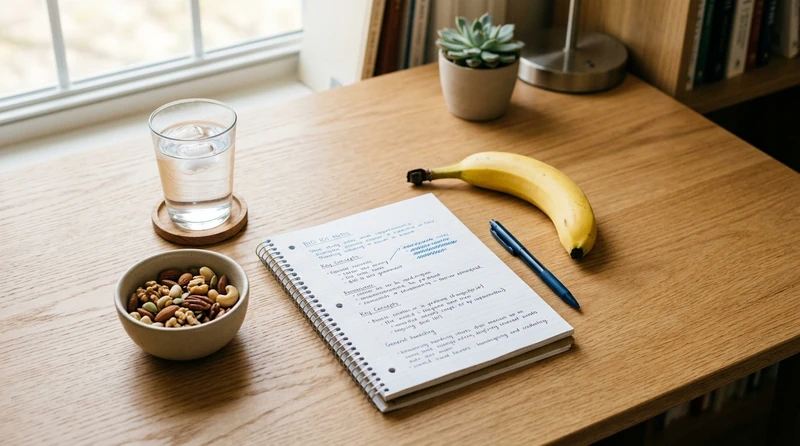
Skipping meals to save time is counterproductive. When blood sugar drops, concentration goes with it. Three loose meals plus an afternoon snack — even if two of those meals are simple — is enough to keep your brain fueled. Keep shelf-stable snacks at your desk: nuts, peanut butter, whole-grain crackers, dried fruit. Having food within reach removes the friction that leads to skipping meals entirely.
High-sugar options spike and crash. Caffeine helps up to a point, then increases anxiety and disrupts sleep. Two to three cups of coffee a day is manageable for most people; drinking a fourth cup at 8 p.m. to power through will cost you two hours of sleep — which is not a good trade.
Movement: Keep It Small
You do not need to maintain a full workout routine during finals. You need enough movement to clear your head and prevent the physical drag of sitting still for eight hours at a stretch.
Ten Minutes Between Blocks
A ten-minute walk between study sessions does more for your focus than forcing yourself through the next section when your concentration is already gone. Brief physical activity increases blood flow to the brain, improves mood, and produces a measurable uptick in alertness. Step outside when you can — natural light accelerates the reset.
Two minutes of stretching between sessions also counts. Physical tension from long sitting compounds mental fatigue — neck, shoulders, back — and keeping yourself comfortable keeps you on task longer.
Breaks and Social Contact: Two Things Students Skip Together
Unplanned breaks that drift into an hour of scrolling are not recovery — they are procrastination with extra guilt. And social contact during finals gets cut first because it feels like a distraction. Both decisions tend to make the final stretch harder.
Structure Your Breaks
Study for 50 minutes, break for 10. Or 90 minutes, break for 20. The numbers matter less than the structure. Knowing the break is coming makes it easier to stay focused; knowing it ends makes it easier to return. A timer removes the willpower cost of both. For a detailed breakdown of this approach, the 90-minute study block method covers timing and what to do in the gaps.
Choose break activities with a natural end point — a walk to a specific spot and back, a snack, a brief conversation. Scrolling has no built-in stopping signal, which is why it reliably expands.
Keep Some Social Contact
You do not need a full evening out. A fifteen-minute conversation with a friend or roommate, a meal eaten with someone else, a brief check-in exchange — these are enough to keep the pressure from becoming completely internal. Social connection measurably reduces stress hormones, and you do not need much of it to feel the difference. Parallel studying — working in the same space in silence — counts and avoids the coordination overhead of a formal group.
Getting Help When the Basics Are Not Enough
A realistic self-care plan keeps most students functional through a normal finals season. But if you are experiencing sleep that will not come regardless of what you try, appetite shifts that go beyond stress eating, or anxiety that makes it hard to sit down and study at all, those are signs worth taking seriously.
Campus counseling centers and health centers typically add short-term appointments during finals — and most students underuse them. If the stress is affecting your grades rather than just your comfort, the guide on how to ask for help at college walks through the resources available and how to use them.
Conclusion
A realistic self-care plan for finals season is not about adding more to your schedule — it is about protecting the basics that make everything else work. Sleep enough to consolidate what you studied. Eat enough to stay fueled. Move enough to clear the fog. Take structured breaks. Maintain enough social contact to stay functional. None of this requires willpower reserves you do not have right now. Treat these as non-negotiable maintenance, and the hardest weeks of the term become survivable.
Frequently Asked Questions
How much sleep do I actually need during finals week?
Seven hours is the realistic floor during finals; eight is ideal. Below six, memory consolidation and recall drop significantly — enough to offset additional study time. Protecting sleep is one of the highest-leverage choices you can make for exam performance.
Is it worth exercising during finals if I am already short on time?
Even ten minutes counts. Brief movement increases blood flow to the brain, improves mood, and restores alertness after a long study block. You do not need a gym session — a short walk between study sessions provides most of the benefit without meaningfully cutting into study time.
What should I eat during finals if I do not have time to cook?
Focus on convenience foods that combine protein and fat: nuts, peanut butter, Greek yogurt, cheese, or whole-grain crackers. These sustain energy better than high-sugar snacks and require no preparation. The goal during a realistic self-care plan is eating something at regular intervals, not eating perfectly.
How do I take a study break without losing an hour to my phone?
Set a timer before the break starts and choose an activity with a natural end point — a walk to a specific location and back, a snack, a short conversation. Scrolling has no built-in stopping signal. A structured break with a fixed length is much easier to end than an open-ended one.
Should I study alone or with others during finals?
Both work, depending on the material. If your exams overlap with a friend's, a study group makes sense. If they do not, parallel studying — working in the same space in silence — gives you the social benefit of company without the coordination cost. Complete isolation tends to amplify stress over a multi-week finals period.
Share this article


Comments 0
No comments yet — be the first.
Leave a comment
Your email will not be published. All fields are required.