

When the deadline stack grows and the exam calendar gets brutal, sleep is almost always the first thing you cut. It feels like a reasonable trade — a few lost hours in exchange for more time with your notes. The problem is that skimping on sleep does not buy you more learning; it costs you what you already have. This guide covers sleep and grades, explains why all-nighters reliably backfire, and lays out a realistic plan for protecting your rest without abandoning your responsibilities.
Why Sleep Is Not Optional for Learning
Sleep is not downtime for your brain — it is when the work of learning actually gets done. During slow-wave and REM sleep, the hippocampus replays the day's experiences and transfers them into long-term storage, a process called memory consolidation. Skip that window and the material you spent hours studying becomes far harder to retrieve when it counts.
Research is specific about the stakes. Studies tracking college students found that sleep factors — duration, quality, and consistency — accounted for nearly 25% of the variance in GPA. That makes sleep roughly as influential on academic performance as study hours themselves. Yet most students treat it as a flexible resource they can borrow against indefinitely.
How Sleep Loss Shows Up in Your Grades
The impact is not abstract or slow-building — it shows up on the next exam.
The GPA Math Is Uncomfortable
A Carnegie Mellon study tracking over 600 undergraduates found that for every hour of sleep lost per night early in the term, end-of-semester GPA dropped by 0.07 points. Students sleeping six hours or fewer consistently posted lower GPAs than those sleeping eight or more. Compound that loss across a semester of compressed sleep and the damage adds up to a meaningful fraction of a letter grade.
Cognitive Decline Happens Faster Than You Think
After two weeks of sleeping six hours a night, your cognitive performance degrades to roughly the level of someone who has gone without sleep for 48 hours straight — but your subjective sense of tiredness stops accurately tracking that decline. You feel okay; you are not. Working memory shrinks, attention lapses multiply, and the hippocampus — your primary learning and retrieval hub — operates at significantly reduced capacity.
Higher-Order Thinking Takes the Hardest Hit
Sleep deprivation hurts all learning, but it hits complex tasks disproportionately hard. Multiple-choice recognition questions suffer; essay exams, problem sets, and any task requiring analysis, synthesis, or application suffer far more. If your courses demand that you argue, calculate, or interpret — not just recall — then lost sleep is costing you points on the questions worth the most.
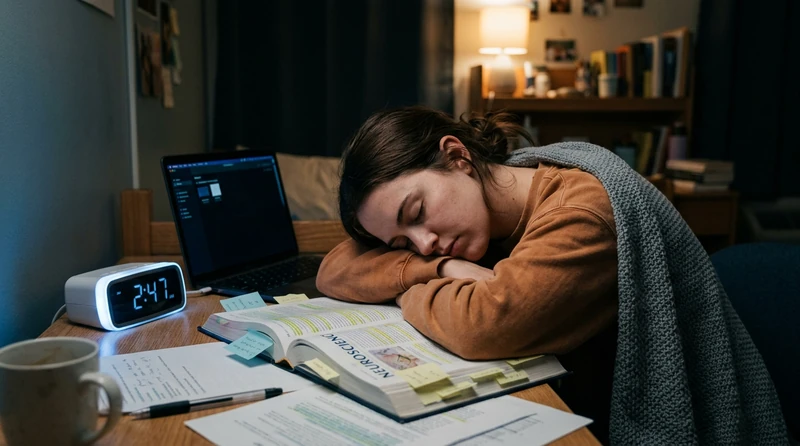
Why All-Nighters Backfire
The all-nighter persists as a student ritual partly because it produces a feeling of effort — you stayed up, you covered material, you suffered for your grade. The feeling is misleading.
The Consolidation Window Closes
The most critical period for memory consolidation is the sleep that immediately follows learning. If that window closes — because you pulled an all-nighter after a full study day — it generally cannot be recovered. Information crammed overnight tends to fade within days rather than persisting for weeks, regardless of how much time you spent on it.
Working Memory Cannot Be Trusted
Even if you load material into short-term memory during an all-nighter, working memory under sleep deprivation is unreliable storage — that information is significantly less likely to be retrievable the following morning. Students often assume that sleeping normally the night before the exam compensates for the prior all-nighter. It does not. Sleep's effect on performance is cumulative across the weeks before a test; a last-minute rescue night changes very little.
A Realistic Plan for Protecting Sleep During a Demanding Term
None of this is useful without a workable approach. The goal is not eight perfect hours every night — it is defending a baseline that keeps your memory consolidation functional.
Set a Non-Negotiable Sleep Floor
Decide on a minimum — seven hours works for most college students — and treat it as a hard constraint when planning your schedule. Work backward from your sleep window rather than forward from your task list. The hours you protect are the hours that make your study time actually pay off.
Front-Load Study Sessions After Class
Sleep's consolidation effect is strongest when it follows learning quickly. Studying in the hour or two after a lecture and then sleeping that night gives your brain the best chance of encoding material durably. Reviewing the same content two days later, sleep-deprived, is far less efficient.
Keep Your Sleep Timing Consistent
Consistent sleep timing — going to bed and waking at roughly the same time each day — matters independently of total hours. Erratic schedules that shift your sleep window by two or more hours disrupt circadian rhythms and impair consolidation even when duration looks adequate. Aim for a 30-minute variance on weekends. Pre-exam weeks are not the time to cut sleep; they are the time to compress review sessions so the floor stays intact.
Getting Help and Going Deeper
Sleep is one part of a broader system. If you are consistently running short on time and sleep is the first thing you cut, the upstream problem is usually how your week is structured — not your willpower. If the pressure feels unmanageable during finals, the Study Horizon guide on finals season self-care covers how to pace yourself through the highest-stress weeks without burning out. And if you need to rebuild your weekly structure from the ground up, the article on time management for students is the right starting point.
Conclusion
The link between sleep and grades is one of the clearest, most consistent findings in educational research. Every hour of sleep you cut is a direct reduction in your brain's ability to consolidate and retrieve what you have studied. All-nighters feel productive and cost you real performance. Protecting your sleep during a demanding term is not a soft recommendation; it is a study tactic with better evidence behind it than most of what students actually do. Start with a sleep floor, build your schedule around it, and treat rest as a non-negotiable input to every exam you sit.
Frequently Asked Questions
How much sleep do college students actually need for good grades?
Most college students need seven to nine hours per night. Research consistently shows that students sleeping six hours or fewer post lower GPAs than those sleeping eight or more. Seven hours is a practical floor — below that, memory consolidation and attention are measurably impaired.
Does sleep before or after studying matter more for memory?
Sleep after studying is the higher-priority window. The consolidation process that locks new information into long-term memory happens during the sleep that follows learning — particularly during slow-wave and REM cycles. Pre-study sleep matters for attention, but post-study sleep is when the material gets filed.
Can you make up for lost sleep on the weekend?
Partial recovery is possible but not complete. A few nights of adequate sleep can restore some cognitive function, but the memories that failed to consolidate during sleep-deprived nights do not reappear. Recovery sleep helps future learning; it does not retrieve what was lost.
Does sleep deprivation hit harder on difficult exams?
Yes, and the gap is significant. The sleep-and-grades relationship is steepest for complex work: analysis, synthesis, and application tasks — the kind that dominate upper-level exams and essays — are hurt far more by sleep loss than simple recall. Students who are confident they can power through demanding material are often the ones most exposed to this effect.
What is the single most effective sleep habit a student can build?
Consistent sleep timing has the strongest evidence behind it. Going to bed and waking up at the same time daily — including weekends — stabilizes circadian rhythms and makes each hour of sleep more restorative. Students with consistent schedules outperform those with the same average duration but erratic timing, because irregular sleep disrupts the consolidation cycles that matter most.
Share this article



Comments 0
No comments yet — be the first.
Leave a comment
Your email will not be published. All fields are required.